
Showing posts with label mystery. Show all posts
Showing posts with label mystery. Show all posts
Sunday, November 2, 2025
The Black Phone (2021)
I can't keep up with all the new horror movies coming out these days - I just don't watch 'em like I used to. But I had a spontaneous opportunity to take a couple teenagers to see Black Phone 2, and so I wanted to watch the first movie first. My patience for the all-too common low effort formula of cheap jump scares punctuated by an audio crescendo (yawn) has seriously flat-lined. Life's too short to waste time watching those kinds of movies. But that's why I loved The Black Phone so much. This is how you do horror - mystery, tension, characters you care about, just the right amount of straight-faced humor, with a creepy premise that touches on some flavor of unsettling horror (pick your poison), in a movie where the bottom line isn't getting girls to jump into their dates' arms while spilling popcorn all over the floor. The pacing was excellent. The soundtrack was excellent. I loved the commitment to the 1970s setting. The characters were interesting. The kids were great. Ethan Hawke was fantastic as the antagonist. Figuring out what was going on with the black phone, and then watching to find out if the protagonist would find a way to escape made the movie enjoyable, without any need for cheap theatrics. It pays when creators take the horror genre seriously, and not treat it as schlock designed to turn a quick buck. I applaud the filmmakers who made The Black Phone, and I look forward to seeing the sequel.

Thursday, September 19, 2024
Leave The World Behind (2023)

With a bit of a quirky style, and a small but memorable supporting cast, I found this movie to be very enjoyable. Even, surprisingly, a little bit funny - as I have a wry sense of humor. With themes that are very topical to the current state of our country, it definitely gets your imagination running.
Some have complained about the ending, but I thought it was perfect. (You hear me, people - perfect! If you changed a single thing about that ending, it would disrupt the narrative and thematic cohesion of the story. Which is why you don't let amateurs write scripts). If you like apocalyptic cinema, I give it a solid recommendation.
Wednesday, October 25, 2023
The Fall of the House of Usher (2023)

I recommend this series on Netflix. Less a straightforward adaptation than a modern reimagining of one of Edgar Allan Poe's classic stories, with plentiful homage to some of his others. Created by Mike Flanagan, who brought us the spectacular The Haunting of Hill House (and its followup, The Haunting of Bly Manor), as well as a bunch of other things I'm just learning about that I might have to check out. Fair warning: there are some pretty aggressive jump scares that are not telegraphed. But where these are usually a cheap ploy used to cover up bad writing, here this is emphatically not the case. Clever story. Good performances. Cynical, but not quite as bleak as the Haunting series. Expect a scary good time.
Wednesday, October 26, 2016
Angel Heart (1987)
Now this is an old-fashioned horror movie. It starts with an intriguing premise - a 1950s era private investigator (Mickey Rourke) hired by a thinly-disguised avatar of the devil (Robert De Niro in a creepy portrayal, if somewhat more by-the-numbers compared to Al Pacino in The Devil's Advocate) to track down a crooner who sold his soul for success, and then wound up a vegetable following his service in the war, precluding the devil from collecting on his contract. But what really sells the film is the atmosphere it exudes, right from the steaming New York City alleyways in the opening shot, to the voodoo-laced streets of New Orleans where the detective eventually ends up. Kudos also to this movie for not holding back, and crossing a particular line few ever dare to cross (even in horror movies that are supposed to be "messed up"). But as with most mysteries, the less I say about the plot, the better. "How terrible is wisdom when it brings no profit to the wise?" Suffice to say that it's an excellent movie worth taking a couple hours out of your schedule sometime to sit down and watch.
Tuesday, May 24, 2016
Twin Peaks (1990-1991)
Twin Peaks is a murder mystery masquerading as a small town soap opera, tinged with an undercurrent of supernatural horror, and the occasional surreal dreamscapes that are David Lynch's trademark. Having seen a few of Lynch's films (starting with the inscrutable and unsettling Eraserhead), I went into this series fully expecting to be utterly confused by the end. You see, Lynch productions are things that you experience, not things that you understand. But while this show is quite intricate (normally, the phrase "Byzantine plot" carries with it an air of pretension, but I really think it applies to this show) - justifying its 30 episode run over two seasons, and leaving enough loose ends to have you wishing there was more - the story settles intriguingly into that realm where most of the time it's just beyond you being able to put all the pieces together (so that it's not too easy to predict what's going to happen next), while not being so far outside the realm of reason as to preclude you from getting a sense that there really is a thread of logic running through everything (whether or not you can figure out what that is). I wonder how much this is due to the influence of Mark Frost, who shares the creator credits with David Lynch.
The majority of the series revolves around the central mystery that develops when, in the first episode, a local homecoming queen turns up dead, prompting an FBI investigation headed by one Dale Cooper (Kyle MacLachlan), paragon of virtue and kindness, and lover of black coffee and cherry pie ("This must be where pies go when they die."). Paired up with local sheriff Harry S. Truman (Michael Ontkean) - you have to check out the donut spreads they get at their local department - Agent Cooper takes to the wild charms of Twin Peaks quickly, endearing the town to the show's audience in the process. But as the layers of the mystery begin to peel back, what at first looks like the tragic slaying of an innocent becomes more complicated, as it's discovered that Laura Palmer was no vestal virgin, and may have been courting the darkness. And beneath Twin Peaks' quaint, small town charm lies a seedy underbelly of drug trafficking and prostitution. But it doesn't end there; vague references to some kind of ancient evil in the woods initiate a slow-burning plot involving supernatural forces.

In the meantime, we are introduced to each of the town's inhabitants, as the show explores their increasingly crisscrossing lives, and the investigation into Laura Palmer's death plays out. Many great actors appear, chiefly recognizable (to me) among them including both Grace Zabriskie and Warren Frost (who played Susan's parents on Seinfeld), as well as Don Davis in a role not completely unrelated to his short-term appearance on The X-Files as Scully's father. Even David Duchovny shows up in a few episodes towards the latter part of the series, as a cross-dressing DEA agent. But I'd just as soon link you to the show's full cast list as recollect all of the great actors and performances (Ray Wise' climax as Leland is one of the highlights) that turn up on the show.

It's easy to become invested in each of the characters' various struggles - Laura's classmates' amateur investigations into her death, and their myriad love troubles; the local business maven's attempt to buy out the town's log mill - and, barring that, resort to manipulating criminal elements in order to get his way; as well as the town's more and less petty criminals' agendas. Running through it all is the mystery of who among these people was Laura's killer. And when the case is finally closed, the show does an effective job of keeping the viewer invested in what follows, to the point that when the final, not entirely conclusive episode (the most mind-bending television finale I've seen since I watched Neon Genesis Evangelion) finishes, you're still left wanting to know, what happens next?

You get the sense that Twin Peaks is a "spectacle show" - that people hear about it, and watch it just to see for themselves how weird it is. But the truth is, it's very good TV in its own right. It's easily the most accessible of David Lynch's projects that I've seen. There are times when the show approaches soap operatic drama, and even effectively executes humor, but its best moments are those that remind you that you are watching a horror series. And the moments that make it stand out among all other shows - including those that were influenced by it, and those that are compared to it - are those inimitably Lynchian flashes of surreality. Nothing else I've watched is quite like Twin Peaks, and it holds up remarkably well, considering its age. I recommend it to anyone who enjoys horror, drama, or just good, classic TV with talented writers, directors, and actors.
The majority of the series revolves around the central mystery that develops when, in the first episode, a local homecoming queen turns up dead, prompting an FBI investigation headed by one Dale Cooper (Kyle MacLachlan), paragon of virtue and kindness, and lover of black coffee and cherry pie ("This must be where pies go when they die."). Paired up with local sheriff Harry S. Truman (Michael Ontkean) - you have to check out the donut spreads they get at their local department - Agent Cooper takes to the wild charms of Twin Peaks quickly, endearing the town to the show's audience in the process. But as the layers of the mystery begin to peel back, what at first looks like the tragic slaying of an innocent becomes more complicated, as it's discovered that Laura Palmer was no vestal virgin, and may have been courting the darkness. And beneath Twin Peaks' quaint, small town charm lies a seedy underbelly of drug trafficking and prostitution. But it doesn't end there; vague references to some kind of ancient evil in the woods initiate a slow-burning plot involving supernatural forces.

There's a sort of evil out there.
Something very, very strange in these old woods.
In the meantime, we are introduced to each of the town's inhabitants, as the show explores their increasingly crisscrossing lives, and the investigation into Laura Palmer's death plays out. Many great actors appear, chiefly recognizable (to me) among them including both Grace Zabriskie and Warren Frost (who played Susan's parents on Seinfeld), as well as Don Davis in a role not completely unrelated to his short-term appearance on The X-Files as Scully's father. Even David Duchovny shows up in a few episodes towards the latter part of the series, as a cross-dressing DEA agent. But I'd just as soon link you to the show's full cast list as recollect all of the great actors and performances (Ray Wise' climax as Leland is one of the highlights) that turn up on the show.

The owls are not what they seem.
It's easy to become invested in each of the characters' various struggles - Laura's classmates' amateur investigations into her death, and their myriad love troubles; the local business maven's attempt to buy out the town's log mill - and, barring that, resort to manipulating criminal elements in order to get his way; as well as the town's more and less petty criminals' agendas. Running through it all is the mystery of who among these people was Laura's killer. And when the case is finally closed, the show does an effective job of keeping the viewer invested in what follows, to the point that when the final, not entirely conclusive episode (the most mind-bending television finale I've seen since I watched Neon Genesis Evangelion) finishes, you're still left wanting to know, what happens next?
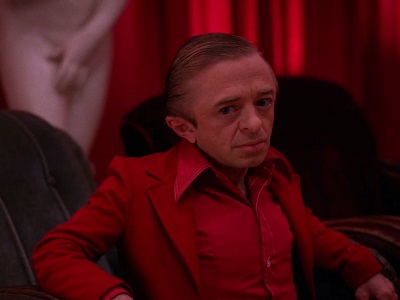
Fire walk with me.
You get the sense that Twin Peaks is a "spectacle show" - that people hear about it, and watch it just to see for themselves how weird it is. But the truth is, it's very good TV in its own right. It's easily the most accessible of David Lynch's projects that I've seen. There are times when the show approaches soap operatic drama, and even effectively executes humor, but its best moments are those that remind you that you are watching a horror series. And the moments that make it stand out among all other shows - including those that were influenced by it, and those that are compared to it - are those inimitably Lynchian flashes of surreality. Nothing else I've watched is quite like Twin Peaks, and it holds up remarkably well, considering its age. I recommend it to anyone who enjoys horror, drama, or just good, classic TV with talented writers, directors, and actors.
Saturday, January 9, 2016
The X-Files - S9:E12 "Underneath"
[ S9:E11 "Audrey Pauley" <<< Season 9 >>> S9:E13 "Improbable" ]
Now this is like what the last season was putting out - classic, dark X-Files representing a return to form. If this season had had more episodes like this one (and less like Lord of the Flies, not to mention the mythology), surely it would have rated higher, or at least could have been labelled an underrated season like 8 was, instead of the confirmation of the show's rapid decline post-Duchovny that it was. This episode's credit goes to John Shiban (one third of the power trio that includes Vince Gilligan and Frank Spotnitz), both for the writing, and for his directorial debut. It's a great episode for Doggett, about the release of a man that he fingered for murder (albeit on circumstantial evidence) back when he was in the NYPD 13 years ago. This event is depicted in the unsettling opener, which effectively captures the fractured psyche of a serial killer - if he really did kill those people. Now, DNA testing has exonerated him, and he's set to walk. But not if Doggett has anything to say about it. He's too close to the case to view it from an objective standpoint, but leave it to Reyes to provide a paranormal explanation involving transubstantiation (unsurprisingly - given the writing this season - involving religious overtones), that could possibly explain the man's guilt despite not leaving any clues tying him directly to the murders, and maybe not even realizing it himself. This is easily one of the highlights of an otherwise underwhelming season.

Memorable quotes:
Doggett: I can't just sit here and wait for this guy to kill again.
Doggett: A cop I know - a man I respect deeply - told me one time, you don't clock out at the end of your shift unless you know you did everything you could.
Bob Fassl: I pray all the time. I pray even when it looks like I'm not praying.
Doggett: You know that what you're sayin's impossible.
Scully: And yet, somehow, it's true.
Damon Kaylor: This isn't about the truth. This is about getting a conviction, Agent Doggett. And if we can't get a conviction, then the truth doesn't matter.
(In other words, the truth is no good without proof).
Now this is like what the last season was putting out - classic, dark X-Files representing a return to form. If this season had had more episodes like this one (and less like Lord of the Flies, not to mention the mythology), surely it would have rated higher, or at least could have been labelled an underrated season like 8 was, instead of the confirmation of the show's rapid decline post-Duchovny that it was. This episode's credit goes to John Shiban (one third of the power trio that includes Vince Gilligan and Frank Spotnitz), both for the writing, and for his directorial debut. It's a great episode for Doggett, about the release of a man that he fingered for murder (albeit on circumstantial evidence) back when he was in the NYPD 13 years ago. This event is depicted in the unsettling opener, which effectively captures the fractured psyche of a serial killer - if he really did kill those people. Now, DNA testing has exonerated him, and he's set to walk. But not if Doggett has anything to say about it. He's too close to the case to view it from an objective standpoint, but leave it to Reyes to provide a paranormal explanation involving transubstantiation (unsurprisingly - given the writing this season - involving religious overtones), that could possibly explain the man's guilt despite not leaving any clues tying him directly to the murders, and maybe not even realizing it himself. This is easily one of the highlights of an otherwise underwhelming season.

Memorable quotes:
Doggett: I can't just sit here and wait for this guy to kill again.
Doggett: A cop I know - a man I respect deeply - told me one time, you don't clock out at the end of your shift unless you know you did everything you could.
Bob Fassl: I pray all the time. I pray even when it looks like I'm not praying.
Doggett: You know that what you're sayin's impossible.
Scully: And yet, somehow, it's true.
Damon Kaylor: This isn't about the truth. This is about getting a conviction, Agent Doggett. And if we can't get a conviction, then the truth doesn't matter.
(In other words, the truth is no good without proof).
Saturday, November 7, 2015
The X-Files - S6:E10 "Tithonus"
[ S6:E9 "S.R. 819" <<< Season 6 >>> S6:E11 "Two Fathers" ]
This episode is a breath of fresh air. It's a classic freak-of-the-week (in spite of the current events it has to twist itself around) - and one of the darker, more introspective ones. This is Vince Gilligan going back to the nihilistic character studies of Pusher and Paper Hearts (or, more recently, Folie a Deux and Drive), not the light-hearted comedic fare of Small Potatoes and Bad Blood. That it's another story involving paranormal photography recalls Unruhe as well, but this is a different sort of story. The freak is sympathetic, if not outwardly affable (in fact, he is exceedingly grim in his demeanor, but for good reason). I hesitate to reveal too much, as it would spoil the mystery of the episode, but the freak in question is a freelance crime scene photographer who always seems to be on the scene when Death is in attendance.
Despite being what I would describe as a "classic" episode, it does have to twist itself around current events. A.D. Kersh gives the case to Scully, pairing her up with a young hotshot investigator (who is a bit of a Ben Affleck look-alike). It's a wonder that Kersh lets her work on what appears (and turns out to indeed be) an X-File - he claims to have hope in rehabilitating Scully as a proper investigator, but you wonder if it's not the case that he simply wants Mulder to suffer by leaving him out of the loop. In any case, the result is a very Scully-centric episode, but it works well (among other things, you've gotta love Scully coming to the rescue of a prostitute being hassled by street scum). The fact that the freak-of-the-week experiences something like death omens recalls Elegy, but also a more serious Clyde Bruckman's Final Repose, in its quiet, brooding portrait of the downsides of immortality. I enjoyed it very much.
Memorable quotes:
Mulder: Hey, Scully, maybe if we get really lucky, next time they'll let us clean toilet bowls.
Scully: Are you ready to quit?
Mulder: No. That would make way too many people way too happy.
Scully: It's not an X-File.
Mulder: That's not what I'm reading. I'm thinking murder by telekinesis. I'm thinking maybe shamanistic death touch. I'm thinking about the Muslim superstition that to photograph someone is to steal their soul.
Scully (sarcastically): Thank you. All very helpful.
Agent Ritter: Hey, I'm confused. I thought we were trying to bust this guy, not look for reasons to let him go.
Scully: I thought we were looking for the truth.
(It's nice to see that some of Mulder's investigative intuition has worn off on Scully. Other investigators are quick to close a case as soon as an easy answer turns up, but a good investigator looks past the easy answers in order to figure out the truth, even when it's a little harder to piece together).
Agent Ritter: You muck up my case, and Kersh will hear about it. Are we clear, Dana?
Scully (quiet, yet firm): Scully. And we're done with this conversation.
Scully: You're saying that this is a photograph of Death itself?
Alfred Fellig: It's a glimpse. Just...a glimpse.
Scully: Mr. Fellig, I know that you know more about photography than I do, but this is just a lens flare.
Alfred Fellig: You're right, I do know more about photography than you do.
(Well-played, Mr. Fellig).
Alfred Fellig: Love lasts...seventy-five years, if you're lucky. You don't wanna be around when it's gone.
Mulder: Death only looks for you once you seek its opposite.
This episode is a breath of fresh air. It's a classic freak-of-the-week (in spite of the current events it has to twist itself around) - and one of the darker, more introspective ones. This is Vince Gilligan going back to the nihilistic character studies of Pusher and Paper Hearts (or, more recently, Folie a Deux and Drive), not the light-hearted comedic fare of Small Potatoes and Bad Blood. That it's another story involving paranormal photography recalls Unruhe as well, but this is a different sort of story. The freak is sympathetic, if not outwardly affable (in fact, he is exceedingly grim in his demeanor, but for good reason). I hesitate to reveal too much, as it would spoil the mystery of the episode, but the freak in question is a freelance crime scene photographer who always seems to be on the scene when Death is in attendance.
Despite being what I would describe as a "classic" episode, it does have to twist itself around current events. A.D. Kersh gives the case to Scully, pairing her up with a young hotshot investigator (who is a bit of a Ben Affleck look-alike). It's a wonder that Kersh lets her work on what appears (and turns out to indeed be) an X-File - he claims to have hope in rehabilitating Scully as a proper investigator, but you wonder if it's not the case that he simply wants Mulder to suffer by leaving him out of the loop. In any case, the result is a very Scully-centric episode, but it works well (among other things, you've gotta love Scully coming to the rescue of a prostitute being hassled by street scum). The fact that the freak-of-the-week experiences something like death omens recalls Elegy, but also a more serious Clyde Bruckman's Final Repose, in its quiet, brooding portrait of the downsides of immortality. I enjoyed it very much.
Memorable quotes:
Mulder: Hey, Scully, maybe if we get really lucky, next time they'll let us clean toilet bowls.
Scully: Are you ready to quit?
Mulder: No. That would make way too many people way too happy.
Scully: It's not an X-File.
Mulder: That's not what I'm reading. I'm thinking murder by telekinesis. I'm thinking maybe shamanistic death touch. I'm thinking about the Muslim superstition that to photograph someone is to steal their soul.
Scully (sarcastically): Thank you. All very helpful.
Agent Ritter: Hey, I'm confused. I thought we were trying to bust this guy, not look for reasons to let him go.
Scully: I thought we were looking for the truth.
(It's nice to see that some of Mulder's investigative intuition has worn off on Scully. Other investigators are quick to close a case as soon as an easy answer turns up, but a good investigator looks past the easy answers in order to figure out the truth, even when it's a little harder to piece together).
Scully (quiet, yet firm): Scully. And we're done with this conversation.
Scully: You're saying that this is a photograph of Death itself?
Alfred Fellig: It's a glimpse. Just...a glimpse.
Scully: Mr. Fellig, I know that you know more about photography than I do, but this is just a lens flare.
Alfred Fellig: You're right, I do know more about photography than you do.
(Well-played, Mr. Fellig).
Alfred Fellig: Love lasts...seventy-five years, if you're lucky. You don't wanna be around when it's gone.
Mulder: Death only looks for you once you seek its opposite.
Wednesday, October 7, 2015
The X-Files - S4:E23 "Demons"
[ S4:E22 "Elegy" <<< Season 4 >>> S4:E23 "Gethsemane" ]
Just two episodes ago, Skinner was being framed for murder. Now it's Mulder's turn, when he wakes up from an unnaturally vivid dream about his childhood, and finds himself in a Rhode Island motel room, covered with somebody else's blood. He doesn't remember anything from the last two days. You know Mulder can't be responsible, but the question remains whether he was framed, or if somebody did something to put him in a different frame of mind. The rest of the episode is dedicated to piecing the mystery together, and is quite fun. In a grim sort of way. It's very centered around Mulder & Scully; it feels like they spend more time together than usual, before splitting up and pursuing different leads. Obviously, Mulder is being bull-headed when he insists on investigating instead of going to the hospital first to see if he's even alright, but in the back of your mind, you're thinking, maybe he's been set up, and once he reports any part of what happened, he may not be given a chance to find the truth about what really happened. So you can forgive him.
I'm gonna put a spoiler warning here, because the rest of this review discusses Mulder's speculations in this episode about his sister's abduction.
Mulder pursues an experimental (and dangerous! - having led previous patients to commit suicide) treatment to unlock his memories, leading him to deduce the existence of a former relationship between his mother and the Smoking Man (which the rest of us learned in Talitha Cumi). He even goes so far as to question his father's paternity. His mother doesn't dignify that with response (which is somehow more suspicious than if she had just said no). But Scully discovers that the doctor's treatment involves a powerful hallucinogen, so the memories can't necessarily be trusted (surprise, surprise). You have to feel bad for Mulder's mother, though. In addition to everything she's been put through on account of the conspiracy, Mulder only ever seems to visit her when he needs to drill her for unsavory details about the past. On the other hand, it shows just how much Samantha's abduction destroyed their family...
Memorable quotes:
Scully: You are taking a big risk, Mulder. I feel strongly about this.
Mulder: I know you do. But it's my risk.
Scully: Mulder, I refuse to believe that you had any part in this.
Mulder: I had those people's blood on my shirt, Scully. I was missing for two days. I have no recollection of my actions during those two days. There were two rounds discharged from my gun. I had the keys to this house, the keys to their car. Do the words Orenthal James Simpson mean anything to you?
Scully: Mulder, I'm gonna get you out of here.
Mulder: You're a doctor, not a lawyer, Scully.
Mulder: Who...is my father?
Mrs. Mulder: What do you want - to kill him again?!
Mulder: Just answer the question, mom. Just answer the question!
Mrs. Mulder: I am your mother, and I will not tolerate any more of your questions!
Scully: What was the last thing he said to you?
Dr. Goldstein: He said he was going to exorcise his demons.
(I don't know why, but the concept of "exorcising one's demons" always stuck with me. That's the one thing I remembered most about this episode).
Just two episodes ago, Skinner was being framed for murder. Now it's Mulder's turn, when he wakes up from an unnaturally vivid dream about his childhood, and finds himself in a Rhode Island motel room, covered with somebody else's blood. He doesn't remember anything from the last two days. You know Mulder can't be responsible, but the question remains whether he was framed, or if somebody did something to put him in a different frame of mind. The rest of the episode is dedicated to piecing the mystery together, and is quite fun. In a grim sort of way. It's very centered around Mulder & Scully; it feels like they spend more time together than usual, before splitting up and pursuing different leads. Obviously, Mulder is being bull-headed when he insists on investigating instead of going to the hospital first to see if he's even alright, but in the back of your mind, you're thinking, maybe he's been set up, and once he reports any part of what happened, he may not be given a chance to find the truth about what really happened. So you can forgive him.
This episode is constructed almost backward (but in a skilled, rather than haphazard way), which makes it far more compelling than if it had been put together in a more straightforward manner. It's also appropriate, given the theme of memory loss (one is reminded a bit of the movie Memento). The main thread - involving an experimental therapy for alien abductees - is almost buried by the drama of Mulder's predicament (even though you know it's coming, it's heartbreaking when the detective finally starts reading Mulder his rights), the weight of his need to remember, and the danger of pursuing those memories at the expense of everything else. It's a very well-crafted episode, written by one-timer R.W. Goodwin, who is responsible for directing a veritable who's who of mythology episodes (The Erlenmeyer Flask, One Breath, Anasazi, The Blessing Way, Talitha Cumi, Herrenvolk, and next week's Gethsemane, along with a couple more). It's no wonder, then, that this is the second non-strictly mythology episode this season (after the daring Paper Hearts) that tackles the issue of Samantha's abduction.
I'm gonna put a spoiler warning here, because the rest of this review discusses Mulder's speculations in this episode about his sister's abduction.
Mulder pursues an experimental (and dangerous! - having led previous patients to commit suicide) treatment to unlock his memories, leading him to deduce the existence of a former relationship between his mother and the Smoking Man (which the rest of us learned in Talitha Cumi). He even goes so far as to question his father's paternity. His mother doesn't dignify that with response (which is somehow more suspicious than if she had just said no). But Scully discovers that the doctor's treatment involves a powerful hallucinogen, so the memories can't necessarily be trusted (surprise, surprise). You have to feel bad for Mulder's mother, though. In addition to everything she's been put through on account of the conspiracy, Mulder only ever seems to visit her when he needs to drill her for unsavory details about the past. On the other hand, it shows just how much Samantha's abduction destroyed their family...
Memorable quotes:
Scully: You are taking a big risk, Mulder. I feel strongly about this.
Mulder: I know you do. But it's my risk.
Scully: Mulder, I refuse to believe that you had any part in this.
Mulder: I had those people's blood on my shirt, Scully. I was missing for two days. I have no recollection of my actions during those two days. There were two rounds discharged from my gun. I had the keys to this house, the keys to their car. Do the words Orenthal James Simpson mean anything to you?
Scully: Mulder, I'm gonna get you out of here.
Mulder: You're a doctor, not a lawyer, Scully.
Mulder: Who...is my father?
Mrs. Mulder: What do you want - to kill him again?!
Mulder: Just answer the question, mom. Just answer the question!
Mrs. Mulder: I am your mother, and I will not tolerate any more of your questions!
Scully: What was the last thing he said to you?
Dr. Goldstein: He said he was going to exorcise his demons.
(I don't know why, but the concept of "exorcising one's demons" always stuck with me. That's the one thing I remembered most about this episode).
Monday, September 14, 2015
The X-Files - S3:E23 "Wetwired"
[ S3:E22 "Quagmire" <<< Season 3 >>> S3:E24 "Talitha Cumi" ]
This is a unique sort of episode. Just when I was starting to think that The X-Files was settling in to a rather more strict demarcation between the monster-of-the-week and the mythology episodes than it's had in the first two seasons (thus making my "one cigarette" rating obsolete), we are given Avatar. And now this. It doesn't feel like a traditional mythology episode - as in F. Emasculata, the emphasis is on conspiracy rather than extraterrestrials - and yet many of the major recurring mythology characters are assembled here (including Mrs. Scully!). (Also, the Smoking Man is referred to directly in this episode for the second time as "Cancer Man"). Plus, like late season 2's Soft Light, it gives us some sorely needed development of the character X (albeit precious little), who has been largely and conspicuously absent for the majority of this season. I fear, however, that, much like in Sleepless, the final scene is but an ominous set-up for something that is about to befall (more on that when it happens).
In this episode, Mulder and Scully investigate the case of a man who appears to be insane, after killing several people he thought were someone else. They find a treasure trove of taped news programs in the perpetrator's house, linking his crimes to reports on a particularly heinous war criminal. Scully suspects a homicidal reaction to violent impulses in the media (though as a skeptical scientist, she should really know better), but Mulder's doubts lead him to search for a less natural stimulus that could trigger such an outburst. Similar cases begin to turn up, and Mulder witnesses a strange device being installed in the telephone poles near the unlikely killers' homes. The Lone Gunmen identify it as a kind of sophisticated transmitter of mind-control signals. Its effects induce paranoid visions in Scully that lend a surreal - almost Lynchian - feel to the proceedings. She goes off the wire, like Mulder did in Anasazi, resulting in a tragic shock and tense standoff. I'm surprised I didn't have a better recollection of this episode, as it's quite good.
Memorable quotes:
Source: This area's always been known for its criminal element.
Mulder: Especially when Congress is in session.
Scully: Recent studies have linked violence on television to violent behavior.
Mulder: Yeah, but those studies are based on the assumption that Americans are just empty vessels ready to be filled with any idea or image that's fed to them - like a bunch of Pavlov dogs - and go out and act on it.
Scully: But they believe that the causal connections are there, Mulder.
Mulder: Studies have also shown causal connections between cow flatulence and the depletion of the ozone layer. What you're talking about is pseudo-science used to make political book.
Scully: I saw things, and I heard things, and...it was just like the world was turned upside-down. Everybody was out to get me.
Mulder: Now you know how I feel most of the time.
Mulder: Why kill them if you wanted me to expose them?
X: Those were always my orders, Agent Mulder. I was just hoping you'd get to them first.
...
Mulder: Where will they stop?
X: That's where you failed, Agent Mulder.
Mulder: Don't lay this off on me, you sneaky son of a bitch. You pulled me into this situation because you didn't have the courage to reveal the truth yourself.
(This is an excellent example of the way X works. He's not gone so soft as to compromise the brutality of his own work for the enemy (whatever Deep Throat may have been responsible for, we never witnessed him murdering somebody in cold blood). He just leaves it all up to Mulder to make things right. And yet he still suffers the consequences).
This is a unique sort of episode. Just when I was starting to think that The X-Files was settling in to a rather more strict demarcation between the monster-of-the-week and the mythology episodes than it's had in the first two seasons (thus making my "one cigarette" rating obsolete), we are given Avatar. And now this. It doesn't feel like a traditional mythology episode - as in F. Emasculata, the emphasis is on conspiracy rather than extraterrestrials - and yet many of the major recurring mythology characters are assembled here (including Mrs. Scully!). (Also, the Smoking Man is referred to directly in this episode for the second time as "Cancer Man"). Plus, like late season 2's Soft Light, it gives us some sorely needed development of the character X (albeit precious little), who has been largely and conspicuously absent for the majority of this season. I fear, however, that, much like in Sleepless, the final scene is but an ominous set-up for something that is about to befall (more on that when it happens).
In this episode, Mulder and Scully investigate the case of a man who appears to be insane, after killing several people he thought were someone else. They find a treasure trove of taped news programs in the perpetrator's house, linking his crimes to reports on a particularly heinous war criminal. Scully suspects a homicidal reaction to violent impulses in the media (though as a skeptical scientist, she should really know better), but Mulder's doubts lead him to search for a less natural stimulus that could trigger such an outburst. Similar cases begin to turn up, and Mulder witnesses a strange device being installed in the telephone poles near the unlikely killers' homes. The Lone Gunmen identify it as a kind of sophisticated transmitter of mind-control signals. Its effects induce paranoid visions in Scully that lend a surreal - almost Lynchian - feel to the proceedings. She goes off the wire, like Mulder did in Anasazi, resulting in a tragic shock and tense standoff. I'm surprised I didn't have a better recollection of this episode, as it's quite good.
Memorable quotes:
Source: This area's always been known for its criminal element.
Mulder: Especially when Congress is in session.
Scully: Recent studies have linked violence on television to violent behavior.
Mulder: Yeah, but those studies are based on the assumption that Americans are just empty vessels ready to be filled with any idea or image that's fed to them - like a bunch of Pavlov dogs - and go out and act on it.
Scully: But they believe that the causal connections are there, Mulder.
Mulder: Studies have also shown causal connections between cow flatulence and the depletion of the ozone layer. What you're talking about is pseudo-science used to make political book.
Scully: I saw things, and I heard things, and...it was just like the world was turned upside-down. Everybody was out to get me.
Mulder: Now you know how I feel most of the time.
Mulder: Why kill them if you wanted me to expose them?
X: Those were always my orders, Agent Mulder. I was just hoping you'd get to them first.
...
Mulder: Where will they stop?
X: That's where you failed, Agent Mulder.
Mulder: Don't lay this off on me, you sneaky son of a bitch. You pulled me into this situation because you didn't have the courage to reveal the truth yourself.
(This is an excellent example of the way X works. He's not gone so soft as to compromise the brutality of his own work for the enemy (whatever Deep Throat may have been responsible for, we never witnessed him murdering somebody in cold blood). He just leaves it all up to Mulder to make things right. And yet he still suffers the consequences).
Thursday, July 23, 2015
The X-Files - S1:E23 "Roland"
[ S1:E22 "Born Again" <<< Season 1 >>> S1:E24 "The Erlenmeyer Flask" ]
This episode starts with a bang, when a mentally-handicapped janitor at a jet propulsion laboratory unexpectedly starts killing scientists in brutal yet creative ways. Mulder and Scully arrive on the scene, first to determine who's responsible for the murders, and then to figure out just how - and why - it's happening. The explanation may appear to involve yet another case of revenge from beyond the grave, but the mechanics of it, and the scientific rather than criminal environment this time, prevent it from feeling too samey. I've mentioned the music on this show already once before, but this episode features a beautiful and haunting piano theme that plays in the background, like something from one of the more sensitive moments in a Silent Hill game.
Memorable quotes:
Scully: Okay, but how is this an X-File? Mulder, you don't think this has anything to do with UFO technology...
Mulder: There's something unexplainable here, Scully, but it's certainly not unidentifiable.
Roland: People die. They go away. And they're not supposed to come back.
Mulder: You got a brother, don't you, Scully?
Scully: Yeah, I've got an older one and a younger one.
Mulder: Well have you ever thought about calling one of them all day long and then all of a sudden the phone rings and it's one of them calling you?
Scully: Does this pitch somehow end with a way for me to lower my long distance charges?
This episode starts with a bang, when a mentally-handicapped janitor at a jet propulsion laboratory unexpectedly starts killing scientists in brutal yet creative ways. Mulder and Scully arrive on the scene, first to determine who's responsible for the murders, and then to figure out just how - and why - it's happening. The explanation may appear to involve yet another case of revenge from beyond the grave, but the mechanics of it, and the scientific rather than criminal environment this time, prevent it from feeling too samey. I've mentioned the music on this show already once before, but this episode features a beautiful and haunting piano theme that plays in the background, like something from one of the more sensitive moments in a Silent Hill game.
Memorable quotes:
Scully: Okay, but how is this an X-File? Mulder, you don't think this has anything to do with UFO technology...
Mulder: There's something unexplainable here, Scully, but it's certainly not unidentifiable.
Roland: People die. They go away. And they're not supposed to come back.
Mulder: You got a brother, don't you, Scully?
Scully: Yeah, I've got an older one and a younger one.
Mulder: Well have you ever thought about calling one of them all day long and then all of a sudden the phone rings and it's one of them calling you?
Scully: Does this pitch somehow end with a way for me to lower my long distance charges?
Monday, January 26, 2015
Vertigo (1958)
James Stewart (who also starred in Rear Window) returns as a police detective who feels compelled to retire after discovering (in a spectacular twilight chase scene over the rooftops of San Francisco that opens the movie) that he suffers from an acute fear of heights. He is goaded into taking one last assignment, however, to tail an old friend's wife (a haunting, haunted Kim Novak), whose husband believes she has been possessed by the ghost of an old ancestor.
Alfred Hitchcock employs his usual creativity as a filmmaker (limited though the technical effects of the time may have been) to bring to life the theme of acrophobia (fear of heights). But though the movie does involve the main character's battle to overcome his fear of heights, it is less the harrowing gauntlet of acrophobic challenges that it could have been, and more a personal study of one man's romantic obsession with a woman, and what it does to him. In that sense, the fear of falling may be related to falling in love, but as this is a Hitchcock film, it's no budding romance, but a neurotic, spiraling plunge into the depths of madness.
The apparent climax to the film seems to come not 3/4 of the way through the movie, followed by a shocking twist that changes the direction of the movie (a technique Hitchcock would perfect in Psycho). Some viewers have criticized the too early placement of a scene that resolves the movie's mystery, but this actually reveals Hitchcock's intention not to tell a conventional murder mystery (instead favoring suspense over surprise), but to focus on the heady effects of obsessive romance on the film's two leads. The denouement following this revelation, however, tends to make the movie feel a bit overlong (with a run time that exceeds the two hour mark), and, like Rear Window, ultimately reaches a conclusion that is startlingly abrupt (if applaudingly stylistic).
Hitchcock's grasp of suspense, characterization, and dialogue is masterful as ever, but he is not without flaw. Vertigo is not an immediately accessible movie, and does not feel altogether satisfying when viewed straight (which probably accounts for its initial panning), although its retroactive reputation as Hitchcock's greatest masterpiece is a testament to the film's intimate personality and ability to inspire obsession in viewers not unlike that the protagonist in the story feels (no less than Martin Scorsese expresses admiration for the film in one of the DVD's bonus features). My own opinion is that this is probably not Hitchcock's best film, and definitely not the greatest movie ever made (not by a long shot), but it demonstrates a talented director's creative attempt at flouting the rules of genre convention, and for that, it earns my respect.
Alfred Hitchcock employs his usual creativity as a filmmaker (limited though the technical effects of the time may have been) to bring to life the theme of acrophobia (fear of heights). But though the movie does involve the main character's battle to overcome his fear of heights, it is less the harrowing gauntlet of acrophobic challenges that it could have been, and more a personal study of one man's romantic obsession with a woman, and what it does to him. In that sense, the fear of falling may be related to falling in love, but as this is a Hitchcock film, it's no budding romance, but a neurotic, spiraling plunge into the depths of madness.
The apparent climax to the film seems to come not 3/4 of the way through the movie, followed by a shocking twist that changes the direction of the movie (a technique Hitchcock would perfect in Psycho). Some viewers have criticized the too early placement of a scene that resolves the movie's mystery, but this actually reveals Hitchcock's intention not to tell a conventional murder mystery (instead favoring suspense over surprise), but to focus on the heady effects of obsessive romance on the film's two leads. The denouement following this revelation, however, tends to make the movie feel a bit overlong (with a run time that exceeds the two hour mark), and, like Rear Window, ultimately reaches a conclusion that is startlingly abrupt (if applaudingly stylistic).
Hitchcock's grasp of suspense, characterization, and dialogue is masterful as ever, but he is not without flaw. Vertigo is not an immediately accessible movie, and does not feel altogether satisfying when viewed straight (which probably accounts for its initial panning), although its retroactive reputation as Hitchcock's greatest masterpiece is a testament to the film's intimate personality and ability to inspire obsession in viewers not unlike that the protagonist in the story feels (no less than Martin Scorsese expresses admiration for the film in one of the DVD's bonus features). My own opinion is that this is probably not Hitchcock's best film, and definitely not the greatest movie ever made (not by a long shot), but it demonstrates a talented director's creative attempt at flouting the rules of genre convention, and for that, it earns my respect.
Wednesday, January 21, 2015
Rear Window (1954)
Right from out of the gate, Rear Window effectively taps in to the audience's voyeuristic impulse. The basic outline of the plot - a journalistic photographer (James Stewart) housebound with a broken leg, bored from six weeks of nothing to do but sit in front of the window - unfolds via a telephone conversation almost in the background, as the camera pans over a fascinating tableau of apartment windows.
The viewer can't help but become absorbed in the curious details of these anonymous people's lives, each one suggesting a different personality, a different lifestyle. The protagonist's simultaneous boredom - and ambivalent fascination - with each of these windows into other people's lives immediately becomes the viewer's. And this is in just the first ten minutes of the movie.
For a time, the protagonist's obsession with voyeurism raises some alarm with his on-call nurse (Thelma Ritter), and glamorous girlfriend (Grace Kelly). But when a few suspicious details linked to a traveling salesman (Raymond Burr) living across the courtyard begin adding up to a picture that looks an awful lot like murder, the desire to look, to pry, to figure out what's going on is downright infectious - the ethics of privacy be damned (much to the chagrin of a skeptical detective played by Wendell Corey).
The movie builds to a fairly tense climax (for its time), even if it takes its merry time getting there. At just barely under two hours, it's pretty long for a movie from the 1950s. However, the characters are likable, even in their imperfections, and their interactions (at times even humorous) are a joy to watch. The ultimate conclusion suits the movie's "murder mystery" atmosphere, although I was hoping for one final plot twist (a la The Simpsons' parody "Bart of Darkness").
But instead of a warning about the ethical concerns of intrusive voyeurism, and how easy it is to jump to conclusions - which could easily become preachy - what we have here is a harrowing glimpse of the horror that occasionally lies just under the surface of everyday life. And that is, perhaps, more suitably frightening. Rear Window is a fantastic movie for its time, and though it has aged a bit in the half century plus since its release, it nevertheless remains compelling, and director Alfred Hitchcock's dedication to the theme of voyeurism is carried through by the filming style in a uniquely effective way.
The viewer can't help but become absorbed in the curious details of these anonymous people's lives, each one suggesting a different personality, a different lifestyle. The protagonist's simultaneous boredom - and ambivalent fascination - with each of these windows into other people's lives immediately becomes the viewer's. And this is in just the first ten minutes of the movie.
For a time, the protagonist's obsession with voyeurism raises some alarm with his on-call nurse (Thelma Ritter), and glamorous girlfriend (Grace Kelly). But when a few suspicious details linked to a traveling salesman (Raymond Burr) living across the courtyard begin adding up to a picture that looks an awful lot like murder, the desire to look, to pry, to figure out what's going on is downright infectious - the ethics of privacy be damned (much to the chagrin of a skeptical detective played by Wendell Corey).
The movie builds to a fairly tense climax (for its time), even if it takes its merry time getting there. At just barely under two hours, it's pretty long for a movie from the 1950s. However, the characters are likable, even in their imperfections, and their interactions (at times even humorous) are a joy to watch. The ultimate conclusion suits the movie's "murder mystery" atmosphere, although I was hoping for one final plot twist (a la The Simpsons' parody "Bart of Darkness").
But instead of a warning about the ethical concerns of intrusive voyeurism, and how easy it is to jump to conclusions - which could easily become preachy - what we have here is a harrowing glimpse of the horror that occasionally lies just under the surface of everyday life. And that is, perhaps, more suitably frightening. Rear Window is a fantastic movie for its time, and though it has aged a bit in the half century plus since its release, it nevertheless remains compelling, and director Alfred Hitchcock's dedication to the theme of voyeurism is carried through by the filming style in a uniquely effective way.
Friday, January 9, 2015
Sound of My Voice (2011)
I had no idea what to expect from this movie when I hit play, and it turned out that I was totally unprepared for it. Although I can't imagine anything that could prepare you for it. My best guess was that it was a horror. It was thoroughly unsettling, but to call it a "horror" doesn't quite do it justice. It is a piece of art. And, like the best and most effective horrors, instead of violence, it relies on mystery, to keep the viewer guessing. Right from the start, it succeeds in creating that truly terrifying atmosphere where you feel like you can't trust the director, and you don't know where the movie is going to end up, and you just don't feel safe.
On its own, this is a devastating technique, but it fits perfectly with the theme of the movie - a documentarian couple's undercover infiltration of a cult centered around an impossibly beautiful woman who claims to be from the future (a startlingly effective Brit Marling). Filmed mainly from the perspective of the infiltrators (but not in the first person, a la found footage), you feel intrinsically vulnerable, because you honestly don't know what the cult is capable of. Even when it fails to do anything obviously evil, you still can't trust it, especially when you see the effects it has on its members. Yet, at the same time, it is strangely captivating, and you're never quite sure what's true and what's a lie. Without relying on any disbelief-suspending tricks, you witness how this cult manages to seduce people (audience included), even as it fails to provide hard evidence to prove its unbelievable claims. It's devastating. And a haunting piece of cinema.
On its own, this is a devastating technique, but it fits perfectly with the theme of the movie - a documentarian couple's undercover infiltration of a cult centered around an impossibly beautiful woman who claims to be from the future (a startlingly effective Brit Marling). Filmed mainly from the perspective of the infiltrators (but not in the first person, a la found footage), you feel intrinsically vulnerable, because you honestly don't know what the cult is capable of. Even when it fails to do anything obviously evil, you still can't trust it, especially when you see the effects it has on its members. Yet, at the same time, it is strangely captivating, and you're never quite sure what's true and what's a lie. Without relying on any disbelief-suspending tricks, you witness how this cult manages to seduce people (audience included), even as it fails to provide hard evidence to prove its unbelievable claims. It's devastating. And a haunting piece of cinema.
Wednesday, November 14, 2012
Eyes Wide Shut (1999)
I didn't really know what to expect from Eyes Wide Shut, but it was one of those movies on my periphery that I had marked as "should check out" but "not in any hurry". However, it came up in a discussion about Mulholland Dr. that I recently watched, so I decided to give it a watch. Also partly because it was directed by Stanley Kubrick. Lots of film buffs rate Stanley Kubrick as one of the greatest directors of all time, but I personally consider him to be overrated, since of his films that I've seen, I've been generally underwhelmed. I think his adaptation of Lolita flopped, and pales in comparison to Adrian Lyne's later version. The Shining is a good horror movie, but would I rate it a masterpiece? I don't know. 2001: A Space Odyssey is a truly inspired piece of science fiction - but as a movie, it just drags on and lacks coherence. And A Clockwork Orange - well, I liked it, but it's not one of the best movies I've ever seen.
So anyway, I heard that this movie was directed by Stanley Kubrick, and I was intrigued by the reference to David Lynch, since I can appreciate Lynch's sensibilities, so I figured I'd give this movie a watch and see if it improves my opinion of Stanley Kubrick as a director. Well, the verdict is that this was a good movie - but it hasn't really changed my opinion of Stanley Kubrick. After all, I don't think he's a bad director, I just don't think he's the best director of all time. But there's other movies of his I have yet to watch, and who knows, my opinion might change in the future. After all, I was underwhelmed by Jimi Hendrix the first time I heard him on the radio!
As for this movie, Eyes Wide Shut, you might call it something of an erotic thriller, but it's really more of a dreamy exploration of psychosexual themes. It stars Tom Cruise and Nicole Kidman - and let me tell you, Nicole Kidman is gorgeous in this movie. And she's not afraid to get a little naked, which earns instant points of respect in my book. Plus, she's gorgeous. Did I say that?
The movie explores various sexual concepts, largely surrounding the theme of fidelity. Like, within the context of marriage. I'll be honest, as a sexual progressive, this couple's concerns were a little unsympathetic to me. I mean, like, it's clear that neither one of them actually cheated on the other. So is it really that devastating to learn that your spouse has sexual fantasies and desires for other people? The thing that's special about committed relationships isn't that people impossibly reign in their sexual interest in other people, but that they refrain from acting on that interest. The vows aren't about "I will never look at another man/woman", but "I will never pursue another man/woman". And that's assuming the couple is into monogamy, which is popular, but as a pro-polyamory type of person, I just don't see it as that big of a deal.
Anyway, it didn't destroy my appreciation for the movie, it just lessened my sympathy for the characters' struggles. The way the movie turns out, after a Christmas party in which both partner has eyes for others, the wife later divulges the fact that there was this one time when she totally had the hots for some naval officer. And Tom Cruise's character breaks down, leaves the house, and basically goes on a hunt for some woman to cheat on his wife with. Although he has a hard time actually going through with it. But his journey, and the people he meets, and the trouble he gets into, is where the film gets really interesting.
And the pinnacle of that is this wild party he sneaks into which is ostensibly attended by some wealthy and/or renowned luminaries, but it's all secretive because everyone wears masks. But they perform this sexual ritual, and they have impossibly beautiful women - albeit hookers and drug addicts and the like - who roam around naked among the cloaked and hooded men, and there's all this sex going on throughout this mansion, right in front of everyone else, and it's every bit as surreal as it is erotic.
And really, the movie's worth it for the erotic themes alone - between Nicole Kidman's beauty, and the women Tom Cruise runs into, and this bizarre sex cult party. But the surreal, dreamy aspect is a nice touch to it. I'd definitely rate it as a good film, and recommend it to anyone who thinks it sounds intriguing.
So anyway, I heard that this movie was directed by Stanley Kubrick, and I was intrigued by the reference to David Lynch, since I can appreciate Lynch's sensibilities, so I figured I'd give this movie a watch and see if it improves my opinion of Stanley Kubrick as a director. Well, the verdict is that this was a good movie - but it hasn't really changed my opinion of Stanley Kubrick. After all, I don't think he's a bad director, I just don't think he's the best director of all time. But there's other movies of his I have yet to watch, and who knows, my opinion might change in the future. After all, I was underwhelmed by Jimi Hendrix the first time I heard him on the radio!
As for this movie, Eyes Wide Shut, you might call it something of an erotic thriller, but it's really more of a dreamy exploration of psychosexual themes. It stars Tom Cruise and Nicole Kidman - and let me tell you, Nicole Kidman is gorgeous in this movie. And she's not afraid to get a little naked, which earns instant points of respect in my book. Plus, she's gorgeous. Did I say that?
The movie explores various sexual concepts, largely surrounding the theme of fidelity. Like, within the context of marriage. I'll be honest, as a sexual progressive, this couple's concerns were a little unsympathetic to me. I mean, like, it's clear that neither one of them actually cheated on the other. So is it really that devastating to learn that your spouse has sexual fantasies and desires for other people? The thing that's special about committed relationships isn't that people impossibly reign in their sexual interest in other people, but that they refrain from acting on that interest. The vows aren't about "I will never look at another man/woman", but "I will never pursue another man/woman". And that's assuming the couple is into monogamy, which is popular, but as a pro-polyamory type of person, I just don't see it as that big of a deal.
Anyway, it didn't destroy my appreciation for the movie, it just lessened my sympathy for the characters' struggles. The way the movie turns out, after a Christmas party in which both partner has eyes for others, the wife later divulges the fact that there was this one time when she totally had the hots for some naval officer. And Tom Cruise's character breaks down, leaves the house, and basically goes on a hunt for some woman to cheat on his wife with. Although he has a hard time actually going through with it. But his journey, and the people he meets, and the trouble he gets into, is where the film gets really interesting.
And the pinnacle of that is this wild party he sneaks into which is ostensibly attended by some wealthy and/or renowned luminaries, but it's all secretive because everyone wears masks. But they perform this sexual ritual, and they have impossibly beautiful women - albeit hookers and drug addicts and the like - who roam around naked among the cloaked and hooded men, and there's all this sex going on throughout this mansion, right in front of everyone else, and it's every bit as surreal as it is erotic.
And really, the movie's worth it for the erotic themes alone - between Nicole Kidman's beauty, and the women Tom Cruise runs into, and this bizarre sex cult party. But the surreal, dreamy aspect is a nice touch to it. I'd definitely rate it as a good film, and recommend it to anyone who thinks it sounds intriguing.
Mulholland Dr. (2001)
I'll be damned if this movie makes any sense at all (although it helps to know that it was a failed-TV-pilot-turned-one-off-film, and this analysis makes me think twice), but you know what? I didn't even mind, because David Lynch has such a talent for creating an atmosphere of mystery and uneasiness. This is true art, and while it makes you think, you don't so much want to put the pieces together as you revel in the feelings that it can evoke in you.
Also, Lynch has an uncanny knack for faces, and he creates such intriguing characters. There's even some real eroticism in this movie, like you so rarely see, between the two female leads - the one of which, Naomi Watts, is, in my opinion, stunning in this role.
I wonder if maybe David Lynch would be better suited to creating shorter pieces (his movies seem frequently to exceed the two hour mark), since he's masterful at creating atmosphere, but his stories rarely seem to tie themselves together in the long run (at least not without extended analysis).
For example, the scene in this movie where the man at the diner is talking about a frightening dream he had. One of the most amazingly unsettling scenes in a movie I've ever seen, and I think it would be just as effective out of context of the rest of the movie - in fact, its connection to the rest of the plot is tenuous at best (or at least not obvious).
And the scene where Bettie goes to audition for the soap role - it's unreal. I'm not even sure what the hell that blue box is, or what the film set has to do with anything - although The Cowboy character was fascinating, and intimidating in his own way.
But as I said, I didn't even care that I couldn't fit all the pieces together, because it was the experience of it, the feelings of uncertainty that David Lynch evokes in you, that make it so captivating. And the music is not only perfectly suited to the mood of the piece, but it's fantastic in its own right.
I very much recommend this movie, even more than the other two Lynch pieces I've seen - Blue Velvet, which wasn't quite as effective for me as this one, and Eraserhead, which was very effective, but perhaps too out there for general audiences.
Also, Lynch has an uncanny knack for faces, and he creates such intriguing characters. There's even some real eroticism in this movie, like you so rarely see, between the two female leads - the one of which, Naomi Watts, is, in my opinion, stunning in this role.
I wonder if maybe David Lynch would be better suited to creating shorter pieces (his movies seem frequently to exceed the two hour mark), since he's masterful at creating atmosphere, but his stories rarely seem to tie themselves together in the long run (at least not without extended analysis).
For example, the scene in this movie where the man at the diner is talking about a frightening dream he had. One of the most amazingly unsettling scenes in a movie I've ever seen, and I think it would be just as effective out of context of the rest of the movie - in fact, its connection to the rest of the plot is tenuous at best (or at least not obvious).
And the scene where Bettie goes to audition for the soap role - it's unreal. I'm not even sure what the hell that blue box is, or what the film set has to do with anything - although The Cowboy character was fascinating, and intimidating in his own way.
But as I said, I didn't even care that I couldn't fit all the pieces together, because it was the experience of it, the feelings of uncertainty that David Lynch evokes in you, that make it so captivating. And the music is not only perfectly suited to the mood of the piece, but it's fantastic in its own right.
I very much recommend this movie, even more than the other two Lynch pieces I've seen - Blue Velvet, which wasn't quite as effective for me as this one, and Eraserhead, which was very effective, but perhaps too out there for general audiences.
Monday, November 5, 2012
Movies I watched this Halloween (2012)
...excepting the ones I've already properly reviewed, of course.
Drag Me To Hell (2011)
When Drag Me To Hell came out in 2011, I filed it in the back of my mind as a potential title to watch, because I love to see the theme of hell in movies (not even just horror movies). I think hell is a fascinating concept, and I love to see different people's interpretations of it. And I thought the premise of this movie was going to be some person who gets dragged down to hell. Which, essentially is what it is, except that the movie is all about this girl being cursed and trying to fight her fate, and not what happens to her after she (huge spoiler) fails to lift the curse and gets dragged down to hell, literally in the last moments of the film (although we see nothing lower than ground level). So, huge disappointment in that respect. As for what the movie actually is, I should have known that coming from Sam Raimi - the man responsible for the slapstick hijinks of the Evil Dead trilogy - I wouldn't like the style. It gets pretty ridiculous at some parts, to the point that I consider it a waste of time. Alison Lohman is beautiful in the lead role, but it's not even worth it to watch just for her performance.
Zombieland (2009)
I had no expectations of loving Zombieland, given that it's more of a horror comedy, and is frequently mentioned in the same breath as Shaun of the Dead, another zombie title hailed as a modern masterpiece by people who don't typically watch horror (hence their ability to appreciate horror comedy). But I was willing to give Shaun of the Dead a watch, and people kept coming to me praising Zombieland, asking if I'd seen it, and it stars both a really hot-looking Emma Stone as well as Abigail Breslin (who was in the fantastic Little Miss Sunshine), so I gave it a watch. It's actually pretty good. The style of the movie is way too light-hearted for me - someone who prefers dark, serious movies - but I can see why a lot of people like it.
Rosemary's Baby (1968)
Rosemary's Baby is a masterpiece of suspense horror directed by Roman Polanski. It gets talked about a lot (for good reason), and I recall seeing at least some scenes from it on TV in the past, but I don't think I'd ever actually sat down and watched the whole thing before, so I made a point to do that this Halloween. It's a fantastic movie, with a fantastic premise - a devil worshipping cult tricks (very cleverly) a young woman into bearing the son of Lucifer. Mia Farrow is sensational in the lead role, as a vulnerable and attractive young mother-to-be. And mad props for actually including the scene where she's raped by the devil - and, better yet, actually including some nudity! Awesome. This is a well-deserved classic horror film and I highly recommend it.
The Omen (1976)
Continuing in the 'devil child' vein, I decided to follow Rosemary's Baby up with The Omen. I remember when the remake came out in 2006 (on the date 6/6/6), though I didn't watch it. But ever since then I've been aware of the original movie from 1976 as a horror classic, and this year I decided to watch it. It's actually very good. There's some mystery and some suspense, and a good bit of horror in the classic, chilling (rather than shocking) vein. And the one scene with the priest and the infernal storm is just awesome. And the dogs manage to actually be intimidating. And the graveyard scene is unforgettable. Great movie, in spite of its age.
The Bad Seed (1956)
This is a movie based off of a stage play about the sweetest little girl you've ever met, who turns out to be a cold-blooded killer. As it is based off a stage play, there is a heavy emphasis on character, and character interaction - which I find to be pretty fascinating (one of my favorite films of all time - Bug - was also adapted from a stage play). Patty McCormack plays the part of the bad seed magnificently, perfectly mixing her innocent charm with a hauntingly believable childlike malice. For a film that's over fifty years old, I rate it very highly and recommend it enthusiastically.
Wilderness Survival For Girls (2004)
This was a fascinating twist of the usual premise in slasher films where a group of young adults head up to a cabin in the woods and get bumped off by some psychotic killer. This time around, it's not so straightforward. Three girls head up to their cabin in the woods, and a suspicious stranger shows up, who claims to have been squatting in their cabin. But the girls have the upper hand, and tie him up in a chair at gunpoint. They wonder if he's the same guy that killed two girls several years ago and was never caught, but they have no hard evidence. The power shifts balance a few times, and the movie addresses the question of what sort of treatment of the stranger is justified by these girls. One the one hand, they're girls, and he's a full grown man. On the other, it's three against one. He might be dangerous, but then, they have no proof. It's an excellent dilemma, with some feminist undertones.
The Gate (1987)
Pretty terrifying for a children's movie. In fact, I'm pretty sure I saw this as a child, but all I remember from it is a scene with the eye in the palm, and the feeling that it was a very, very scary movie. As an adult, okay, it's not that terrifying, but it's still a really good movie. I miss the days when they made movies for kids that were actually good and not cheap schlock to placate the whiny runts. And the fx - I assume it's claymation - are really pretty good. I mean, like, you can tell they're not real, but they're infinitely more effective than shoddy CGI. And the creature design - especially the big daddy (which recalled for me the excellent monster design in Howard The Duck) - was fantastic, not ridiculous like a lot of today's monsters. And my favorite part of all (aside from the cute teenage sister) was the fact that the movie didn't shy away from being epic. This is sort of a spoiler, but most movies would build up to the end of the world and stop short. This movie doesn't pull any punches. Bravo.
The Mothman Prophecies (2002)
The Mothman Prophecies is a movie that constructs a really creepy atmosphere. It's more of a mystery thriller than a straight-up horror, but I thought it was scary in its own way. Unfortunately, the cryptid angle leaves a little to be desired, but what you get in place of that is a very fascinating premise about prognostication and determinism, with some very haunting scenes. It's also a very sad, sad story. But I definitely get a feel from it that it could totally have been an extended episode of The X-Files - it's just missing Mulder and Scully...
Candyman (1992)
Candyman is a movie that I've been meaning to watch ever since I read Clive Barker's Books of Blood. Clive Barker is a horror writer who is the mastermind behind Hellraiser, and the story that the movie Candyman is based on was in the Books of Blood I read. The movie, I'm sure, expands and modifies the story to a full feature-length format, but I think Clive Barker was involved in its production, and anyway, the result is pretty good. In the story, Candyman is something of an urban legend - he's a real, supernatural villain, but he derives power from the beliefs of those he frightens. And the movie is the story of one woman's journey to discover the truth behind the myth, and the subsequent horrors she is then confronted with. It's pretty good.
Red State (2011)
After the debacle that was Drag Me To Hell, I could be forgiven for skipping over Red State, being that I'm not generally a fan of Kevin Smith's other forays into cinema, however popular they are. But, I had heard that this - horror - movie was actually pretty good, so I wanted to give it a watch. It was worth it. It is ostensibly the story of a fundamentalist religious group (obviously inspired by the Westboro Baptist Church, which was in the news for picketing the funeral of a gay man beaten to death), and the ungodly horrors they get up to in their private church, which involve online entrapment schemes and very criminal 'neutralization' of perverts. Anyway, this is kind of a spoiler, but the movie takes a left turn midway through and introduces the government by turning the situation into something very much like the Waco Massacre. The result is actually very fascinating in my opinion (although others seem frustrated by the lack of thematic focus). In the end, I think the movie provides a good opportunity to criticize the errors of both religion and government, with only the perverts really making out well in the end (at least image-wise). But, that could be my bias, since I am a pervert (and proud). Anyway, it was a really fascinating movie, and I do recommend it. And, as most people who have seen it agree, Michael Parks does a hauntingly captivating job in the role of the crazy, bigoted preacher man.
Alone With Her (2006)
Alone With Her is pretty much your typical crazy stalker story, although it cleverly uses the 'found footage' angle to its advantage so that we get to see the story unfold entirely from the point of view of the stalker's cameras. Which, gives it a kind of creepy feeling because it's almost like you're participating in the stalker's crimes. People will naturally criticize the voyeuristic element, but especially from the perspective of cinema, which is an inherently voyeuristic medium (and that's why we love it!), it's only natural to be curious. It's when the stalker uses voyeurism as a method to criminally invade another person's privacy, and then take advantage of that inside perspective to exercise unknowing control over that person's life, in a futile attempt to construct a scripted scenario that's doomed from the start, that it becomes creepy. Anyway, it's certainly a unique perspective, even if on a somewhat cliched narrative.
Megan Is Missing (2011)
Megan Is Missing purportedly claims to be an open warning about what can happen to teens who meet strangers on the internet, loosely based on any number of real life abduction cases (but no one in particular). But rather than a preventive education piece, it's climax is so horrifying as to make it a startlingly effective horror film instead. That's not to say that it's actually a good film, by cinematic standards - for one thing, the acting is terribly shoddy, as the majority of the characters try way too hard (or not hard enough) to behave like caricatures of either way-too-slutty or self-pitying teens. But the film takes the found footage technique to its logical conclusion by documenting via webcam and mobile phone what it is teens get up to when parents aren't around, and then marrying that with footage taken by the killer after one or more of those teens is abducted. Where this film succeeds is in going farther and being bolder than any movie before it (that I know of), in an attempt to document the true horror of what goes on in those most terrible of cases - the very thing most people instinctively desire to turn away from. The last 22 minutes of this movie is, in fact, so effective, that I describe it as pure nightmare fuel, and one of the most disturbing cinema experiences of my life - and I've seen both Irreversible, and Salò, or the 120 Days of Sodom. Really, it's a shame the movie is so terribly acted, because as a horror it's terrifyingly effective. But, I can't really recommend it to anyone, because it's just that bone-chilling, and merely thinking about it scares me - me!
Little Sweetheart (1989)
This is not actually a horror movie but more of a crime drama, but it features a character that is very much a "bad seed", not unlike in the movie of that title. She's nine years old, and played by a very charismatic, though unknown (like this whole movie, apparently), Cassie Barasch. She gets up to all sorts of misdeeds with her reluctant friend and cohort, including spying on a couple that just moved in nearby who are on the run after committing insurance fraud. Little Thelma (that's the girl's character's name) ends up blackmailing them for shopping money, and things just go downhill from there. It's a really fun movie, and the leading character's natural penchant for criminal mischievousness is fascinating to watch. It's a seemingly unheard of movie, but I recommend it highly.
Texas Killing Fields (2011)
Texas Killing Fields is a heavily atmospheric little number with an excellent swampy soundtrack. It's a bit of a crime suspense thriller, and the story was a little hard to follow, but I honestly didn't even mind, because the characters' motivations were pretty easy to suss out - and, I'll be honest, I really go for a movie that can construct a good atmosphere. Plus, Chloe Moretz stars in a supporting role, and she always lights up the screen, even when she's playing (as she frequently does) a downtrodden child with a lot of things to be depressed about, but nevertheless with a good head on her shoulders, and the ability to somehow maintain a fragment of her innocence through it all. I don't think this movie got much acclaim when it came out (I wasn't able to get around to seeing it, though I wanted to), but I liked it.
Drag Me To Hell (2011)
When Drag Me To Hell came out in 2011, I filed it in the back of my mind as a potential title to watch, because I love to see the theme of hell in movies (not even just horror movies). I think hell is a fascinating concept, and I love to see different people's interpretations of it. And I thought the premise of this movie was going to be some person who gets dragged down to hell. Which, essentially is what it is, except that the movie is all about this girl being cursed and trying to fight her fate, and not what happens to her after she (huge spoiler) fails to lift the curse and gets dragged down to hell, literally in the last moments of the film (although we see nothing lower than ground level). So, huge disappointment in that respect. As for what the movie actually is, I should have known that coming from Sam Raimi - the man responsible for the slapstick hijinks of the Evil Dead trilogy - I wouldn't like the style. It gets pretty ridiculous at some parts, to the point that I consider it a waste of time. Alison Lohman is beautiful in the lead role, but it's not even worth it to watch just for her performance.
Zombieland (2009)
I had no expectations of loving Zombieland, given that it's more of a horror comedy, and is frequently mentioned in the same breath as Shaun of the Dead, another zombie title hailed as a modern masterpiece by people who don't typically watch horror (hence their ability to appreciate horror comedy). But I was willing to give Shaun of the Dead a watch, and people kept coming to me praising Zombieland, asking if I'd seen it, and it stars both a really hot-looking Emma Stone as well as Abigail Breslin (who was in the fantastic Little Miss Sunshine), so I gave it a watch. It's actually pretty good. The style of the movie is way too light-hearted for me - someone who prefers dark, serious movies - but I can see why a lot of people like it.
Rosemary's Baby (1968)
Rosemary's Baby is a masterpiece of suspense horror directed by Roman Polanski. It gets talked about a lot (for good reason), and I recall seeing at least some scenes from it on TV in the past, but I don't think I'd ever actually sat down and watched the whole thing before, so I made a point to do that this Halloween. It's a fantastic movie, with a fantastic premise - a devil worshipping cult tricks (very cleverly) a young woman into bearing the son of Lucifer. Mia Farrow is sensational in the lead role, as a vulnerable and attractive young mother-to-be. And mad props for actually including the scene where she's raped by the devil - and, better yet, actually including some nudity! Awesome. This is a well-deserved classic horror film and I highly recommend it.
The Omen (1976)
Continuing in the 'devil child' vein, I decided to follow Rosemary's Baby up with The Omen. I remember when the remake came out in 2006 (on the date 6/6/6), though I didn't watch it. But ever since then I've been aware of the original movie from 1976 as a horror classic, and this year I decided to watch it. It's actually very good. There's some mystery and some suspense, and a good bit of horror in the classic, chilling (rather than shocking) vein. And the one scene with the priest and the infernal storm is just awesome. And the dogs manage to actually be intimidating. And the graveyard scene is unforgettable. Great movie, in spite of its age.
The Bad Seed (1956)
This is a movie based off of a stage play about the sweetest little girl you've ever met, who turns out to be a cold-blooded killer. As it is based off a stage play, there is a heavy emphasis on character, and character interaction - which I find to be pretty fascinating (one of my favorite films of all time - Bug - was also adapted from a stage play). Patty McCormack plays the part of the bad seed magnificently, perfectly mixing her innocent charm with a hauntingly believable childlike malice. For a film that's over fifty years old, I rate it very highly and recommend it enthusiastically.
Wilderness Survival For Girls (2004)
This was a fascinating twist of the usual premise in slasher films where a group of young adults head up to a cabin in the woods and get bumped off by some psychotic killer. This time around, it's not so straightforward. Three girls head up to their cabin in the woods, and a suspicious stranger shows up, who claims to have been squatting in their cabin. But the girls have the upper hand, and tie him up in a chair at gunpoint. They wonder if he's the same guy that killed two girls several years ago and was never caught, but they have no hard evidence. The power shifts balance a few times, and the movie addresses the question of what sort of treatment of the stranger is justified by these girls. One the one hand, they're girls, and he's a full grown man. On the other, it's three against one. He might be dangerous, but then, they have no proof. It's an excellent dilemma, with some feminist undertones.
The Gate (1987)
Pretty terrifying for a children's movie. In fact, I'm pretty sure I saw this as a child, but all I remember from it is a scene with the eye in the palm, and the feeling that it was a very, very scary movie. As an adult, okay, it's not that terrifying, but it's still a really good movie. I miss the days when they made movies for kids that were actually good and not cheap schlock to placate the whiny runts. And the fx - I assume it's claymation - are really pretty good. I mean, like, you can tell they're not real, but they're infinitely more effective than shoddy CGI. And the creature design - especially the big daddy (which recalled for me the excellent monster design in Howard The Duck) - was fantastic, not ridiculous like a lot of today's monsters. And my favorite part of all (aside from the cute teenage sister) was the fact that the movie didn't shy away from being epic. This is sort of a spoiler, but most movies would build up to the end of the world and stop short. This movie doesn't pull any punches. Bravo.
The Mothman Prophecies (2002)
The Mothman Prophecies is a movie that constructs a really creepy atmosphere. It's more of a mystery thriller than a straight-up horror, but I thought it was scary in its own way. Unfortunately, the cryptid angle leaves a little to be desired, but what you get in place of that is a very fascinating premise about prognostication and determinism, with some very haunting scenes. It's also a very sad, sad story. But I definitely get a feel from it that it could totally have been an extended episode of The X-Files - it's just missing Mulder and Scully...
Candyman (1992)
Candyman is a movie that I've been meaning to watch ever since I read Clive Barker's Books of Blood. Clive Barker is a horror writer who is the mastermind behind Hellraiser, and the story that the movie Candyman is based on was in the Books of Blood I read. The movie, I'm sure, expands and modifies the story to a full feature-length format, but I think Clive Barker was involved in its production, and anyway, the result is pretty good. In the story, Candyman is something of an urban legend - he's a real, supernatural villain, but he derives power from the beliefs of those he frightens. And the movie is the story of one woman's journey to discover the truth behind the myth, and the subsequent horrors she is then confronted with. It's pretty good.
Red State (2011)
After the debacle that was Drag Me To Hell, I could be forgiven for skipping over Red State, being that I'm not generally a fan of Kevin Smith's other forays into cinema, however popular they are. But, I had heard that this - horror - movie was actually pretty good, so I wanted to give it a watch. It was worth it. It is ostensibly the story of a fundamentalist religious group (obviously inspired by the Westboro Baptist Church, which was in the news for picketing the funeral of a gay man beaten to death), and the ungodly horrors they get up to in their private church, which involve online entrapment schemes and very criminal 'neutralization' of perverts. Anyway, this is kind of a spoiler, but the movie takes a left turn midway through and introduces the government by turning the situation into something very much like the Waco Massacre. The result is actually very fascinating in my opinion (although others seem frustrated by the lack of thematic focus). In the end, I think the movie provides a good opportunity to criticize the errors of both religion and government, with only the perverts really making out well in the end (at least image-wise). But, that could be my bias, since I am a pervert (and proud). Anyway, it was a really fascinating movie, and I do recommend it. And, as most people who have seen it agree, Michael Parks does a hauntingly captivating job in the role of the crazy, bigoted preacher man.
Alone With Her (2006)
Alone With Her is pretty much your typical crazy stalker story, although it cleverly uses the 'found footage' angle to its advantage so that we get to see the story unfold entirely from the point of view of the stalker's cameras. Which, gives it a kind of creepy feeling because it's almost like you're participating in the stalker's crimes. People will naturally criticize the voyeuristic element, but especially from the perspective of cinema, which is an inherently voyeuristic medium (and that's why we love it!), it's only natural to be curious. It's when the stalker uses voyeurism as a method to criminally invade another person's privacy, and then take advantage of that inside perspective to exercise unknowing control over that person's life, in a futile attempt to construct a scripted scenario that's doomed from the start, that it becomes creepy. Anyway, it's certainly a unique perspective, even if on a somewhat cliched narrative.
Megan Is Missing (2011)
Megan Is Missing purportedly claims to be an open warning about what can happen to teens who meet strangers on the internet, loosely based on any number of real life abduction cases (but no one in particular). But rather than a preventive education piece, it's climax is so horrifying as to make it a startlingly effective horror film instead. That's not to say that it's actually a good film, by cinematic standards - for one thing, the acting is terribly shoddy, as the majority of the characters try way too hard (or not hard enough) to behave like caricatures of either way-too-slutty or self-pitying teens. But the film takes the found footage technique to its logical conclusion by documenting via webcam and mobile phone what it is teens get up to when parents aren't around, and then marrying that with footage taken by the killer after one or more of those teens is abducted. Where this film succeeds is in going farther and being bolder than any movie before it (that I know of), in an attempt to document the true horror of what goes on in those most terrible of cases - the very thing most people instinctively desire to turn away from. The last 22 minutes of this movie is, in fact, so effective, that I describe it as pure nightmare fuel, and one of the most disturbing cinema experiences of my life - and I've seen both Irreversible, and Salò, or the 120 Days of Sodom. Really, it's a shame the movie is so terribly acted, because as a horror it's terrifyingly effective. But, I can't really recommend it to anyone, because it's just that bone-chilling, and merely thinking about it scares me - me!
Little Sweetheart (1989)
This is not actually a horror movie but more of a crime drama, but it features a character that is very much a "bad seed", not unlike in the movie of that title. She's nine years old, and played by a very charismatic, though unknown (like this whole movie, apparently), Cassie Barasch. She gets up to all sorts of misdeeds with her reluctant friend and cohort, including spying on a couple that just moved in nearby who are on the run after committing insurance fraud. Little Thelma (that's the girl's character's name) ends up blackmailing them for shopping money, and things just go downhill from there. It's a really fun movie, and the leading character's natural penchant for criminal mischievousness is fascinating to watch. It's a seemingly unheard of movie, but I recommend it highly.
Texas Killing Fields (2011)
Texas Killing Fields is a heavily atmospheric little number with an excellent swampy soundtrack. It's a bit of a crime suspense thriller, and the story was a little hard to follow, but I honestly didn't even mind, because the characters' motivations were pretty easy to suss out - and, I'll be honest, I really go for a movie that can construct a good atmosphere. Plus, Chloe Moretz stars in a supporting role, and she always lights up the screen, even when she's playing (as she frequently does) a downtrodden child with a lot of things to be depressed about, but nevertheless with a good head on her shoulders, and the ability to somehow maintain a fragment of her innocence through it all. I don't think this movie got much acclaim when it came out (I wasn't able to get around to seeing it, though I wanted to), but I liked it.
Monday, November 21, 2011
Red Riding Hood (2011)
Red Riding Hood is, basically, The Little Red Riding Hood adapted for the Twilight generation. It's not a bad movie, but it's not a terribly good movie either. As a fantasy, it's not very convincing. As a drama, it's not very believable. It's too smooth to be very scary, although it works decently as a thriller. But the CG is distractingly obvious - horror requires grit and substance.
The film works best as a mystery - indeed, I was compelled to continue watching largely to find out who turns out to be the wolf. I don't know that it's a good mystery, because though there were many legitimate candidates for wolfhood (Red Riding Hood not excluded, with the woodsman ironically being the most visibly suggestive candidate), I wasn't invested enough in the fantasy world to care about following all the clues and making note of the 'rules' (assuming they're consistent), so I don't know whether it's actually intelligent or just lazy. But it is a mystery that wants solving, even if the paranoid atmosphere recalls much better films that have gone the "killer among us" route.
However, in spite of how it turns out, I'd be just as willing to believe that Father Solomon was running a racket, tricking villages into submission by introducing werewolves that only he knows how to effectively fight. I guess that shows you how unconvincing the characters were, that I'd just as soon believe them to be something else, rather than what the script apparently intends. I find it amusing in a not necessarily constructive manner that this is not the first film in which Gary Oldman has played a character who fights werewolves (harking back to Sirius Black in The Prisoner of Azkaban).
If not effective, it is a pretty film, helped in no small part by the luscious features of Amanda Seyfried as not-so-little Red herself. Although she is gorgeous, and has a more childlike demeanor than most women her age, I couldn't help noticing that she's not as young as her character is portrayed. Though she's not supposed to be a child, as she is in the prologue, when the narration jumps ten years into the future, it looks more like twenty years have passed. And I have a hard time believing that in this [admittedly make-believe] pre-modern era, one's parents would wait until a girl is twenty-five to arrange her marriage, and that, being as beautiful as she evidently is, noone else would have made arrangements of their own long before that time.
Now, I have no problem with an 'adult' telling of Red Riding Hood (actually, the original version is said to have been pretty gruesome already), but I've seen it done better before; and if you're going to make it 'adult', you might as well make it gritty. Red Riding Hood is sensual and romantic, but it's not sexy. It's mysterious and thrilling, but it's not really frightening. And most unfortunate of all, it tends to drag in the way that you feel like somebody had the idea to put their own spin on the story, but it's something that would have been better accomplished in a shorter format (or else with a better script) - here, the less-than-satisfying filling brings down those elements of the story that might actually be clever and/or original.
The film works best as a mystery - indeed, I was compelled to continue watching largely to find out who turns out to be the wolf. I don't know that it's a good mystery, because though there were many legitimate candidates for wolfhood (Red Riding Hood not excluded, with the woodsman ironically being the most visibly suggestive candidate), I wasn't invested enough in the fantasy world to care about following all the clues and making note of the 'rules' (assuming they're consistent), so I don't know whether it's actually intelligent or just lazy. But it is a mystery that wants solving, even if the paranoid atmosphere recalls much better films that have gone the "killer among us" route.
However, in spite of how it turns out, I'd be just as willing to believe that Father Solomon was running a racket, tricking villages into submission by introducing werewolves that only he knows how to effectively fight. I guess that shows you how unconvincing the characters were, that I'd just as soon believe them to be something else, rather than what the script apparently intends. I find it amusing in a not necessarily constructive manner that this is not the first film in which Gary Oldman has played a character who fights werewolves (harking back to Sirius Black in The Prisoner of Azkaban).
If not effective, it is a pretty film, helped in no small part by the luscious features of Amanda Seyfried as not-so-little Red herself. Although she is gorgeous, and has a more childlike demeanor than most women her age, I couldn't help noticing that she's not as young as her character is portrayed. Though she's not supposed to be a child, as she is in the prologue, when the narration jumps ten years into the future, it looks more like twenty years have passed. And I have a hard time believing that in this [admittedly make-believe] pre-modern era, one's parents would wait until a girl is twenty-five to arrange her marriage, and that, being as beautiful as she evidently is, noone else would have made arrangements of their own long before that time.
Now, I have no problem with an 'adult' telling of Red Riding Hood (actually, the original version is said to have been pretty gruesome already), but I've seen it done better before; and if you're going to make it 'adult', you might as well make it gritty. Red Riding Hood is sensual and romantic, but it's not sexy. It's mysterious and thrilling, but it's not really frightening. And most unfortunate of all, it tends to drag in the way that you feel like somebody had the idea to put their own spin on the story, but it's something that would have been better accomplished in a shorter format (or else with a better script) - here, the less-than-satisfying filling brings down those elements of the story that might actually be clever and/or original.
Saturday, June 11, 2011
Super 8 (2011)
Tonight was the anticipated release of the new J.J. Abrams project, produced by Steven Spielberg, and starring Dakota's lovely sister Elle Fanning - the film titled Super 8. It's rare that I go out to see a movie on opening day (or in the theater at all) - not because I wouldn't like to, but because I can't afford to. But I figured that considering my current obsession with Dakota Fanning, it would be insane to pass up the opportunity to see this exciting new film her sister is starring in. Plus, I've been hearing good things about it.
Having now seen it - and gone to unusual lengths to get to the theater - I can say that it was definitely worth the effort. Hype doesn't tell me anything because every movie gets hyped up, and not every one deserves it. But forget what people are saying, this movie is a lot of fun. It has something that so many films lack - style. It's funny, but not in the way that the comedy is forced. The conversation is natural, and you laugh because the characters are genuinely funny, and also genuinely charming. But this isn't a comedy, and that's why it works. The humor makes watching the film a fun experience, but it's not what you're there for, you're there for the story.
What I didn't realize about this film until the last minute is that it's actually a retro '70s throwback film. And that's where a lot of the style comes into play. It's not over-the-top in the same way that an exploitation film is - like the recent grindhouse throwbacks: Planet Terror, Death Proof, Machete, etc. But it has that same kind of freewheeling love-of-the-cinema atmosphere. And it does go over-the-top in a few humorously ridiculous action scenes. And since the story within the story is about these kids directing a homemade movie of their own (a zombie film), that really drives home the point that this is a movie created by people who really love making movies.
Elle Fanning is really great in this role. But the rest of the cast - especially the main gang of kids - all hold their own in creating a lovable ensemble. I fear this may be a rather strong statement, but I'm tempted to say that Super 8 is The Goonies of the 21st century.
My brother was worried that the movie would turn out to be a lot sappier than the trailers (that I saw) suggest. There is some drama in this movie, but it's sweet, and it doesn't take away from the excitement, or the action. There's room for feelings in a movie like this; if you want a brutal two hours of film with no morals and no sensitivity, there are other titles to suit that bill (many that I've seen, and many that I've liked). But this movie, this movie is about having a good time.
I could say some things about the monster, but I'm hesitant to spoil anything. I'll try to be discreet, but as usual, if you really don't want to be spoiled, skip ahead to the next paragraph now. I'm tempted to call this film sort of a Cloverfield Jr. My standards for monsters in monster films are pretty high. Rarely do you get something as terrifying as H.R. Giger's xenomorph, or as horrific as John Carpenter's The Thing. I would rate the monster in Super 8 as falling short of being truly impressive, but good enough to hold the story. After all, this is less of a horror movie than a sci-fi thriller.
For those concerned about this being one of those shaky-cam found-footage type films, it's not like that at all. The production values throughout the film are solid.
In short, you should definitely go out and see this film. It's not just a good movie, it's a really fun movie to watch. And that's something you don't see every day.
Having now seen it - and gone to unusual lengths to get to the theater - I can say that it was definitely worth the effort. Hype doesn't tell me anything because every movie gets hyped up, and not every one deserves it. But forget what people are saying, this movie is a lot of fun. It has something that so many films lack - style. It's funny, but not in the way that the comedy is forced. The conversation is natural, and you laugh because the characters are genuinely funny, and also genuinely charming. But this isn't a comedy, and that's why it works. The humor makes watching the film a fun experience, but it's not what you're there for, you're there for the story.
What I didn't realize about this film until the last minute is that it's actually a retro '70s throwback film. And that's where a lot of the style comes into play. It's not over-the-top in the same way that an exploitation film is - like the recent grindhouse throwbacks: Planet Terror, Death Proof, Machete, etc. But it has that same kind of freewheeling love-of-the-cinema atmosphere. And it does go over-the-top in a few humorously ridiculous action scenes. And since the story within the story is about these kids directing a homemade movie of their own (a zombie film), that really drives home the point that this is a movie created by people who really love making movies.
Elle Fanning is really great in this role. But the rest of the cast - especially the main gang of kids - all hold their own in creating a lovable ensemble. I fear this may be a rather strong statement, but I'm tempted to say that Super 8 is The Goonies of the 21st century.
My brother was worried that the movie would turn out to be a lot sappier than the trailers (that I saw) suggest. There is some drama in this movie, but it's sweet, and it doesn't take away from the excitement, or the action. There's room for feelings in a movie like this; if you want a brutal two hours of film with no morals and no sensitivity, there are other titles to suit that bill (many that I've seen, and many that I've liked). But this movie, this movie is about having a good time.
I could say some things about the monster, but I'm hesitant to spoil anything. I'll try to be discreet, but as usual, if you really don't want to be spoiled, skip ahead to the next paragraph now. I'm tempted to call this film sort of a Cloverfield Jr. My standards for monsters in monster films are pretty high. Rarely do you get something as terrifying as H.R. Giger's xenomorph, or as horrific as John Carpenter's The Thing. I would rate the monster in Super 8 as falling short of being truly impressive, but good enough to hold the story. After all, this is less of a horror movie than a sci-fi thriller.
For those concerned about this being one of those shaky-cam found-footage type films, it's not like that at all. The production values throughout the film are solid.
In short, you should definitely go out and see this film. It's not just a good movie, it's a really fun movie to watch. And that's something you don't see every day.
Thursday, February 24, 2011
Hidden (2009)
Note: This review is part of my coverage of Horrorfest IV.
Hidden
Now Hidden I liked a lot. It's the foreign film of the batch. (Note: British/Australian etc. films don't count as foreign only because their language is still English). Every Horrorfest has one film that's not in English. But unlike past years, this one is not Asian, but Norwegian. It's kind of convoluted (which I actually tend to like), but that means it reminds me of films like Crazy Eights, and The Abandoned - also because it's about a man who returns to the house of his childhood to uncover secrets from the past. There also tends to be at least one doppelganger film in every Horrorfest, and this year I think I'd have to split that honor between this film and Lake Mungo. Here, it's not really clear whether the doppelganger is really that, or something else, but then, a lot of doppelganger stories tend to be subtle and suggestive, and not easily pinned down, don't they?
This film has a very intriguing plot. It all revolves around an abusive mother. Her son escapes one night, and while running through the woods, causes a truck to crash into a car by the side of the road, killing another little boy's parents. The son apparently escapes, only to return decades later when his mother has finally died, and he inherits the house. The house appears to be haunted - or is someone still living there? What happened to the little boy whose parents were killed is a bit of a mystery. The cops were convinced that he fell off a cliff into a huge (and very beautiful) waterfall in those woods, after wandering around the night of the crash that killed his parents. Yet there's also some speculation that -
I might be spoiling a little bit here, but I think it helps to talk this stuff out, since the film is less than completely clear - but if you don't want to be spoiled, you might want to skip ahead to the next film.
There's also some speculation that the boy may have been captured by the abusive mother and taken in place of the son who escaped. Is he still alive, after all these years, living in that house? But whether or not there really is a second individual, is under suspicion. And the true identity of the man who returns to the house is also unclear. What really happened that night of the crash? I'm not even sure myself, after seeing the movie. It's one of those films where the credits roll and you're still left guessing at this and that. Which is good fun, if you ask me, but I hate when there's not really an answer key. I like to be given clues and have time to work theories out and such, but when the right answer is left open-ended, it leaves me feeling like, "well, if there's no 'right' answer, then why bother trying to find it?" And if there are clues leading to alternate conclusions, and neither one is necessarily correct, well... Interpretation is a great thing, but I think it would be interesting to know what the director/writer intended.
Great film, though. Good atmosphere. Captivating characters. Beautiful (and also creepy) environment. I like the mood and the tone of the film. And it makes you think, which is always a plus in my book. It would probably frustrate a lot of people (even me, to some extent), but I really liked it.
Hidden
Now Hidden I liked a lot. It's the foreign film of the batch. (Note: British/Australian etc. films don't count as foreign only because their language is still English). Every Horrorfest has one film that's not in English. But unlike past years, this one is not Asian, but Norwegian. It's kind of convoluted (which I actually tend to like), but that means it reminds me of films like Crazy Eights, and The Abandoned - also because it's about a man who returns to the house of his childhood to uncover secrets from the past. There also tends to be at least one doppelganger film in every Horrorfest, and this year I think I'd have to split that honor between this film and Lake Mungo. Here, it's not really clear whether the doppelganger is really that, or something else, but then, a lot of doppelganger stories tend to be subtle and suggestive, and not easily pinned down, don't they?
This film has a very intriguing plot. It all revolves around an abusive mother. Her son escapes one night, and while running through the woods, causes a truck to crash into a car by the side of the road, killing another little boy's parents. The son apparently escapes, only to return decades later when his mother has finally died, and he inherits the house. The house appears to be haunted - or is someone still living there? What happened to the little boy whose parents were killed is a bit of a mystery. The cops were convinced that he fell off a cliff into a huge (and very beautiful) waterfall in those woods, after wandering around the night of the crash that killed his parents. Yet there's also some speculation that -
I might be spoiling a little bit here, but I think it helps to talk this stuff out, since the film is less than completely clear - but if you don't want to be spoiled, you might want to skip ahead to the next film.
There's also some speculation that the boy may have been captured by the abusive mother and taken in place of the son who escaped. Is he still alive, after all these years, living in that house? But whether or not there really is a second individual, is under suspicion. And the true identity of the man who returns to the house is also unclear. What really happened that night of the crash? I'm not even sure myself, after seeing the movie. It's one of those films where the credits roll and you're still left guessing at this and that. Which is good fun, if you ask me, but I hate when there's not really an answer key. I like to be given clues and have time to work theories out and such, but when the right answer is left open-ended, it leaves me feeling like, "well, if there's no 'right' answer, then why bother trying to find it?" And if there are clues leading to alternate conclusions, and neither one is necessarily correct, well... Interpretation is a great thing, but I think it would be interesting to know what the director/writer intended.
Great film, though. Good atmosphere. Captivating characters. Beautiful (and also creepy) environment. I like the mood and the tone of the film. And it makes you think, which is always a plus in my book. It would probably frustrate a lot of people (even me, to some extent), but I really liked it.
Sunday, June 28, 2009
Innocence (2004)
Note: This review was originally posted on Bridge To Better Days. I am reposting it here for archival purposes. It has been backdated to the date of its original posting.
I recently stumbled upon a film titled Innocence, based on a rather old story (written in the 19th century, I believe). The film is directed by Lucile Hadzihalilovic, who I understand is the wife of Gaspar Noé, known for his cinematic masterpiece Irréversible. Both of the above-mentioned films share cinematographer Benoît Debie, which is a significant point to mention. But where Irréversible impressed me, Innocence spoke to me. Deeply.
I'll resist overdoing the praise, as I don't want to overhype the film, since it surely won't affect everyone the way it affected me, but the truth is I have very rarely been moved by a film (or anything, really) to this extent, and never in quite exactly this way. The last time I remember being so moved by a film was the first time I saw Lost & Delirious. After viewing the tragic love story, I fell into a depression, but the thing that perplexed me was the idea that something so utterly depressing, could also be so incredibly beautiful - and vice versa.
If you want to experience Innocence, go and experience it, but don't read the rest of this review, since foreknowledge is the very antithesis of the subject involved, and once lost, innocence cannot easily be regained, if at all. Otherwise, read on.

Innocence opens with the arrival of a young girl, in a coffin, with no possessions, at what appears to be a boarding school. We then explore the school through the girl's eyes (figuratively speaking), with the wonder and mystery of a child's innocence. This fact is what makes the film such a powerful experience. I didn't realize what it was exactly until after the fact, but watching this movie put me into a state of childlike innocence that allowed me to experience the story as the characters must.

Questions go unanswered as we gradually learn the rules, and throughout the entire film a foreboding sense of dread and uneasiness, executed perfectly by the cinematography, haunts our thoughts and expectations as we query the scenes laid before us. Make no mistake, this was one of the most terrifying films I have ever seen - and nothing really happens. It's not a horror film. It's the anticipation, and the not knowing, and the formulation in our less than innocent minds of dark possibilities that fuels the fear that is then stirred on by the juxtaposition of sounds and images on the screen.

But the ultimate realization is that everything is more or less normal, safe, okay. This is life. And this is growing up. The uncertainty of the wider world encroaching on one's familiar surroundings as they grow and are forced to come to terms with the cycles of life. The film appears to be rife with symbolism, but more important than the specifics, is the overarching theme, which we have been discussing. It really is a fascinating experience, and this film stands alone in its unique execution.

And above all of that, there is one quality that stands out for me. It is the dread that I mentioned earlier. The feeling of anxiety and fear about what will eventually, if we allow ourselves to advance that far, become known as ordinary and unthreatening. I suspect that I am unique in this aspect, in my perception of the world, my individual perspective. When you watch most films, at least the type that are meant mostly for entertainment and not much else, the atmosphere is usually casual and nonthreatening. Like the construct of the world is taken for granted, it's just there, doing its thing, and okay, now let's get to the more important things going on.

I feel like this is more or less the way most people view the world, with their own exceptions, of course. And that is a perspective I've never really been privy to. For you see, my perspective of the world, the way I interpret the things and places and people and situations placed before me, mirrors that of this film, Innocence. I see the world with dread. What's perfectly normal appears to me as threatening, and uncertain. Every little detail may hide unknown, and unthinkable, terrors. And so, the film speaks to me, deeply and personally.
To others, this film might be a frightening alternate perspective on reality, where little is known for certain and all is threatening with the potential for danger. To me, this is my reality.

I recently stumbled upon a film titled Innocence, based on a rather old story (written in the 19th century, I believe). The film is directed by Lucile Hadzihalilovic, who I understand is the wife of Gaspar Noé, known for his cinematic masterpiece Irréversible. Both of the above-mentioned films share cinematographer Benoît Debie, which is a significant point to mention. But where Irréversible impressed me, Innocence spoke to me. Deeply.
I'll resist overdoing the praise, as I don't want to overhype the film, since it surely won't affect everyone the way it affected me, but the truth is I have very rarely been moved by a film (or anything, really) to this extent, and never in quite exactly this way. The last time I remember being so moved by a film was the first time I saw Lost & Delirious. After viewing the tragic love story, I fell into a depression, but the thing that perplexed me was the idea that something so utterly depressing, could also be so incredibly beautiful - and vice versa.
If you want to experience Innocence, go and experience it, but don't read the rest of this review, since foreknowledge is the very antithesis of the subject involved, and once lost, innocence cannot easily be regained, if at all. Otherwise, read on.
Innocence opens with the arrival of a young girl, in a coffin, with no possessions, at what appears to be a boarding school. We then explore the school through the girl's eyes (figuratively speaking), with the wonder and mystery of a child's innocence. This fact is what makes the film such a powerful experience. I didn't realize what it was exactly until after the fact, but watching this movie put me into a state of childlike innocence that allowed me to experience the story as the characters must.
Questions go unanswered as we gradually learn the rules, and throughout the entire film a foreboding sense of dread and uneasiness, executed perfectly by the cinematography, haunts our thoughts and expectations as we query the scenes laid before us. Make no mistake, this was one of the most terrifying films I have ever seen - and nothing really happens. It's not a horror film. It's the anticipation, and the not knowing, and the formulation in our less than innocent minds of dark possibilities that fuels the fear that is then stirred on by the juxtaposition of sounds and images on the screen.
But the ultimate realization is that everything is more or less normal, safe, okay. This is life. And this is growing up. The uncertainty of the wider world encroaching on one's familiar surroundings as they grow and are forced to come to terms with the cycles of life. The film appears to be rife with symbolism, but more important than the specifics, is the overarching theme, which we have been discussing. It really is a fascinating experience, and this film stands alone in its unique execution.
And above all of that, there is one quality that stands out for me. It is the dread that I mentioned earlier. The feeling of anxiety and fear about what will eventually, if we allow ourselves to advance that far, become known as ordinary and unthreatening. I suspect that I am unique in this aspect, in my perception of the world, my individual perspective. When you watch most films, at least the type that are meant mostly for entertainment and not much else, the atmosphere is usually casual and nonthreatening. Like the construct of the world is taken for granted, it's just there, doing its thing, and okay, now let's get to the more important things going on.
I feel like this is more or less the way most people view the world, with their own exceptions, of course. And that is a perspective I've never really been privy to. For you see, my perspective of the world, the way I interpret the things and places and people and situations placed before me, mirrors that of this film, Innocence. I see the world with dread. What's perfectly normal appears to me as threatening, and uncertain. Every little detail may hide unknown, and unthinkable, terrors. And so, the film speaks to me, deeply and personally.
To others, this film might be a frightening alternate perspective on reality, where little is known for certain and all is threatening with the potential for danger. To me, this is my reality.
Subscribe to:
Posts (Atom)